
Brooklyn • New York
University of Miami School of Architecture
ACSA Steel Competition
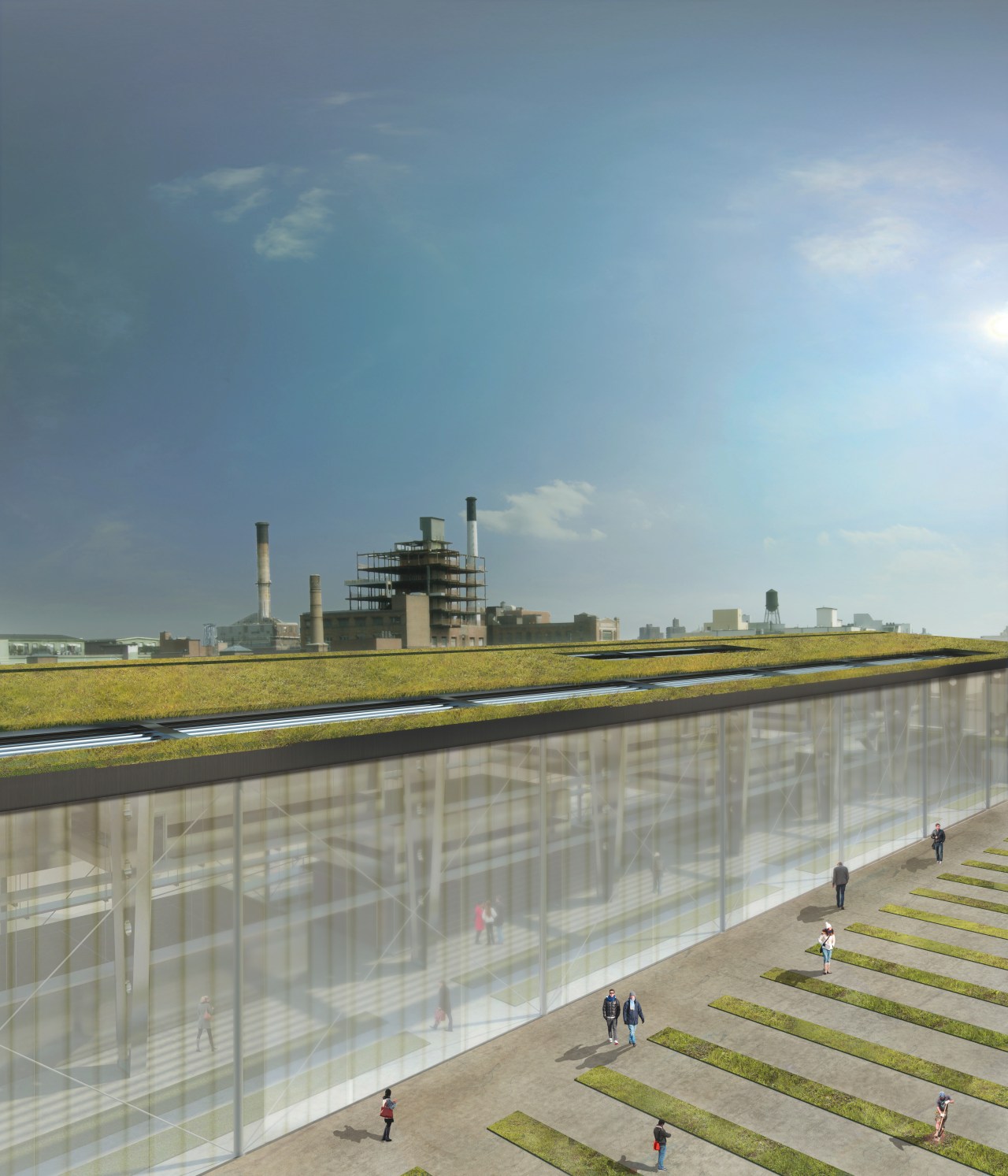
The project concept stemmed from the notion of growth. Top priority was given to the ability for the structure to meet the needs for future expansion. Using a bar-like shape allots an abundant amount of flexibility within building, while also creating an urban edge along the outstretched periphery of the site. The elongated form provides an expanse ideal for planter space that would be used to grow crops. Using glass walls to create solar heat is an efficient way to reap harvest yearlong, as it is essential for the project’s geographical location. The use of steel is an integral aspect of the project. Its properties make it possible to work in tension as well as in compression, which creates stronger, yet smaller and lighter structural components. Since the design uses a repetitious module, the steel parts are similar to one another; therefore, during production, material waste may be reduced significantly. The life-giving building, in a sense, gives the school the chance to continually generate income. Another important sustainable initiative the urban farm can offer is reduce future costs of shipping produce to the location as well as the use of gas for transport. In addition to producing crops on site as a way for the restaurant, as well as the academic portion of the program, to be self-sufficient, it also serves as a medium for interaction with the community. In order for the original concept of growth to succeed, the design of the building must ensure to withstand time by providing for future needs of the project’s program. Modules became evident as an economical way for the structure to expand slowly over time. Each module will hold a space for each portion of the program: teaching kitchens, classrooms, and a lounge space. Above the ground floor, a cat-walk is the main form of circulation between each module, or part. As the building uses the kit-of-parts method, when an addition is necessary, the entire module can be ordered piece by piece. Once all the pieces are delivered to the site, assembly can begin and then be hoisted into the desired location.


 barashidesign.com